


WHAT IS SULTANATE OF WOMEN?
This era was marked by the political dominance of wives and mothers of Ottoman sultans. From 1566, following the death of Sultan Suleiman the Magnificent, until 1683, nine different sultans ascended the Ottoman throne. Several of them were minors at the time of their accession. Consequently, their mothers governed the empire from the imperial harem as regents, exercising absolute authority.
This period is particularly compelling for two primary reasons:
- In a predominantly patriarchal Ottoman society, political power was traditionally vested in sultans and their viziers, while women were largely absent from public life.
- With the exception of Mihrimah Sultan, all these women entered Topkapi Palace as young slaves. Through careful selection and in some cases fortune, they became the sultan’s favoured consorts, bore royal heirs and occasionally attained the status of legal wives. In effect, former slave women governed the empire along Grand Viziers, who themselves were often slaves too.
Viewed from this perspective, the Sultanate of Women emerges as an extraordinary historical phenomenon.
Most visitors to Istanbul tend to focus on its most renowned landmarks such as Hagia Sophia, the Blue Mosque, Topkapi Palace and the Grand Bazaar. However, Ottoman Istanbul extends far beyond these iconic monuments.
You can explore the city through many insightful historical lenses. In this post, you will discover historic sites in Istanbul linked specifically to Safiye Sultan. Of course, these may not be the only buildings associated with her. She may have commissioned other structures across Istanbul and the wider Ottoman Empire.
SAFIYE SULTAN
The next influential woman of the Sultanate of Women was Safiye Sultan, the powerful Haseki Sultan of Sultan Murad III. Her influence grew significantly after the deaths of Nurbanu Sultan and, especially, Murad III. When her son, Mehmed III, ascended the throne, she became Valide Sultan, giving her the two most powerful titles in the Ottoman Empire.
Safiye Sultan lived in the Topkapi Palace during the reigns of seven sultans: Suleiman the Magnificent, Selim II, Murad III, Mehmed III, Ahmed I, Mustafa I and Osman II.
According to Venetian sources, Safiye was of Albanian origin and became a concubine of Şehzade Murad, the eldest son of the future Sultan Selim II. In 1566, the same year Sultan Suleiman the Magnificent died, she gave birth to Murad’s first son, Şehzade Mehmed.
After Sultan Selim II’s death in 1574, Safiye officially took the title of Haseki Sultan. However, she struggled to gain influence. Murad’s mother, Nurbanu Sultan, together with Grand Vizier Sokollu Mehmed Pasha, continued to dominate state affairs and the palace harem.
To avoid further conflict between Nurbanu and Safiye, Sultan Murad III sent Safiye to the Old Palace in 1580, where she remained until Nurbanu’s death in 1583.
SAFIYE SULTAN – SUPREME RULER OF THE EMPIRE
Safiye returned to Topkapi Palace and took control of the harem. She also began involving herself in state affairs, becoming one of the most powerful figures of Sultan Murad III’s reign.
When Sultan Murad III died in 1595, her son Mehmed III became the new sultan, marking the beginning of Safiye Sultan’s period of supreme authority within the Ottoman Empire, an era that lasted until Mehmed III’s death in 1603.
Her son discussed all major matters with her, never making decisions without her approval. Both the public and state officials approached her directly for help, sometimes even throwing themselves in front of her carriage to gain her attention.
Safiye’s influence was immense. She controlled the appointments and dismissals of high-ranking officials, including the Grand Vizier and the Shaykh al-Islam, as well as many others employed by the state.
She also ordered the execution of her grandson Şehzade Mahmud in 1603, believing he posed a threat to her authority and her son’s rule.
When Sultan Mehmed III died in 1603, his son Ahmed I became the new sultan. He immediately stripped Safiye of her power and sent her back to the Old Palace, ending her 19 year period of dominance.
YENI MOSQUE
One of Istanbul’s most iconic landmarks, the Yeni Mosque in Eminönü, was originally commissioned by Safiye Sultan in 1597.

By establishing a mosque in that part of Istanbul, Safiye aimed to assert Islamic influence over what had been a predominantly Jewish neighbourhood.

However, after Mehmed III’s death in 1603 and Safiye’s fall from power, the new sultan Ahmed I abandoned the project, redirecting resources toward that would become the grand and world famous Blue Mosque.

The unfinished construction site fell into ruin and was further damaged during the Great Fire of 1660.
That same year, the imperial architect Mustafa Ağa proposed to Turhan Hatice Sultan to complete this mosque. She agreed and also ordered the construction of the now famous Spice Bazaar as part of the imperial complex.
The mosque was completed in 1665 and opened for worship. Initially known as the Yeni Valide Sultan Mosque, it eventually became simply the Yeni Mosque.

During my visit to Istanbul in 2019, the mosque was undergoing restoration. Only a small portion was open for prayers and tourists were not allowed inside. On my visit in 2024, I finally saw it in its full restored beauty.
I couldn’t find any other major sites in Istanbul directly connected to Safiye Sultan. However, there is a mosque named after her in Cairo – the Al-Malika Safiye Mosque.

SAFIYE SULTAN TOMB
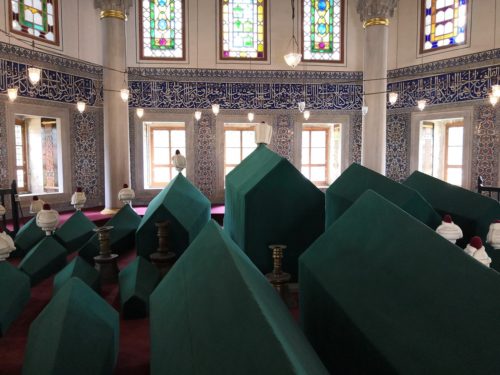
Safiye Sultan died in 1619, sixteen years after her exile to the Old Palace. She is buried in the Sultan Murad III mausoleum, located next to Hagia Sophia.
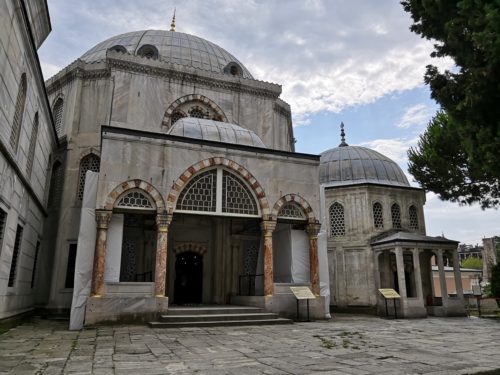
You can easily identify her coffin at the centre of the mausoleum, beside her husband Sultan Murad III. The site is beautifully decorated with classic Iznik tiles, making it an exceptional historical location.
There is no shortage of articles on Safiye Sultan available online. Yet, for those who study the Ottoman Empire or simply hold an interest in this remarkable period of its history, this overview may provide a clearer understanding of Safiye’s life as reflected through the legacy that she left in modern day Istanbul.
With one of the city’s most recognisable architectural landmarks closely associated with her name, Safiye Sultan’s memory endures. As long as the Yeni Mosque stands, her presence will remain woven into the historical and cultural fabric of Istanbul.
Back to Turkey